Sorry, you need to enable JavaScript to visit this website.
Skip page header and navigation

East Midlands Collaborative

Hidden East Midlands Collaborative

Creativity Collaboratives Nottingham

In Nottingham, 12 schools within the Nottingham Schools Trust come together as a community of practice to explore this overarching question over a three year period.

How can we improve the way our schools nurture children’s innate creative capacity and sustain their curiosity about the world?

We did this by:

1. Prioritised teachers’ professional learning about teaching for creativity

2. Created effective communities of practice that include teachers, creative practitioners and cultural education partners

3. Built networks of events, support and school governance that sustain teaching for creativity

4. Built strong school connections to local cultures and heritage and supported the development of children’s sense of place

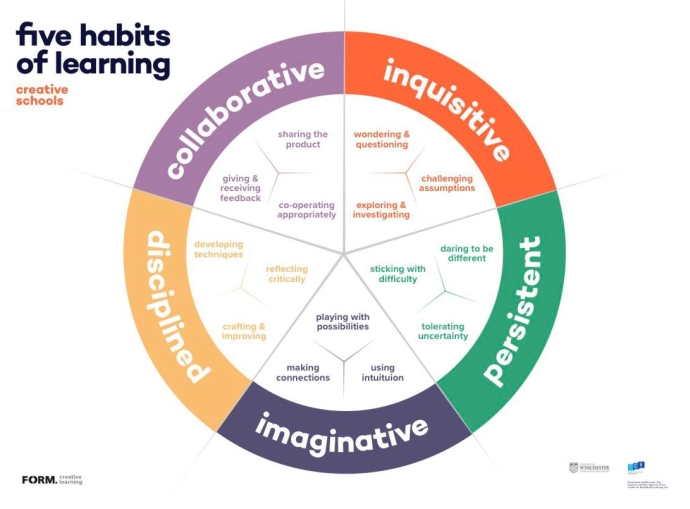
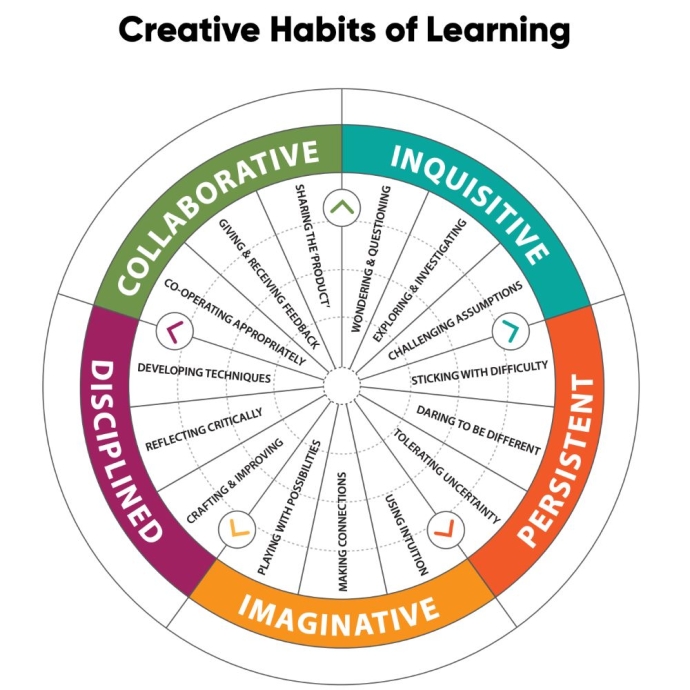
There were regular opportunities to connect with Professor Bill Lucas and teachers from around the country within a national peer learning network. The ‘Creative Habits of Mind Wheel’ was a useful tool through which to reflect on our own creative confidence and the residency programmes with creative practitioners. You can see the different images of the wheel below.

Graphic with the text 'Creativity Collaboratives Nottingham.' 'Creativity' appears in bold white letters on a red background, 'Collaboratives' on a teal background, and 'Nottingham' slightly tilted on a separate teal background below.
Circular diagram titled 'five habits of learning' with colored segments: Collaborative, Inquisitive, Persistent, Imaginative, and Disciplined, each with brief behavior descriptions. Center is blurred; logos appear in bottom corners
Partially visible circular diagram titled 'Creative Habits of Learning,' with colored segments representing different habits. The visible segments include 'Persistent' in orange and another teal segment. The rest of the diagram is blurred and unreadable.

Guidance for creative professionals and teachers on how to use the creativity wheel

This widely used model of creativity was developed by Professor Bill Lucas and colleagues at the University of Winchester.

It can be used as a formative assessment tool in that it can help pupils to:

  • Develop a shared language of creativity.
  • Reflect, self assess and value their own creative skills/disposition
  • Gather supporting evidence.
  • Track their progress over time.
  • Be more self aware of when they are using their creative skills.
  • Seek opportunities to be more creative; and to identify future learning goals.

It can help creative professionals and teachers to:

  • Have a shared language of creativity across the school community.
  • To create a dialogue in the school about the value of developing creative skills.
  • Consider how to build opportunities for creative skill development in learning.
  • Develop their practice; and support reflection and goal setting with learners.

Get in touch with Creativity Collaboratives Nottingham using the details below:

Twitter: @ChalleNGeNottm or @NST_forschools

Website: challengenottingham.co.uk

Other years

In Year 1, twelve Nottingham schools explored how to nurture creativity and curiosity by focusing on teacher development, creative partnerships, and connecting learning to local culture.

Children sit on a classroom floor around a standing adult. Faces are pixelated for privacy. The room features colorful posters with words like 'Responsibility' and 'Enjoyment,' blue curtains, and a bookshelf in the background.

In year two, the Creativity Collaborative Nottingham deepened its focus on child-led learning, expanding creative practices and partnerships to nurture curiosity and sustain creativity—guided by four key priorities.

Children in a classroom or gym take part in an activity. One raises an arm, another gestures, and a third wears a 'YOU GOT THIS' shirt. Faces are obscured. Blue curtains and artwork are in the background.

In its final year, the Nottingham Creativity Collaborative worked to sustain its impact by strengthening school–culture sector partnerships and rolling out the Cultural Rucksack to give all students access to local creative opportunities.

Children on a grassy field participate in an outdoor activity, walking in pairs. Some are blindfolded with green or orange cloths, while their partners guide them by holding their shoulders or arms. A building and trees are visible in the background